
2 Weeks in Thailand: Temples, Festivals & Street Food
Bangkok · Chiang Mai · Pai · Koh Lanta · Koh Phi Phi
Thailand rewards every effort made to understand it — a country of extraordinary temples, genuinely warm people, the world’s finest street food, and a Buddhist culture so pervasive it shapes everything from architecture to daily rhythm. This 14-day itinerary moves from Bangkok’s urban intensity through the ancient temples of Chiang Mai to the emerald islands of the Andaman Sea.
Quick Reference
| Best Time | November–April (cool season). Avoid May–October (heavy monsoon in south and central) |
| Daily Budget | USD 40–80/day mid-range |
| Currency | Thai Baht (THB). ATMs everywhere; charge ₿200 fee per withdrawal. |
| Visa | US, UK, AU, CA: visa-free 30 days (now extended to 60 days). Extendable. |
| Key Custom | Remove shoes at temple entrances. Cover shoulders and knees. Never touch monk’s robes. |
| Transport | Overnight trains Bangkok→Chiang Mai (~$15 sleeper). Domestic flights $20–50. |
Day-by-Day Itinerary
Days 1–3 — Bangkok: Temples and Street Food
Day 1 — Grand Palace and Wat Pho
Begin at the Grand Palace (THB500) — the official residence of the Kings of Thailand since 1782, a complex of throne halls, pavilions, and Wat Phra Kaew (Temple of the Emerald Buddha). The Emerald Buddha is a 66cm jade figure that is one of the most sacred objects in Thai Buddhism — the king changes its gold costume three times a year for each season. Across the road: Wat Pho — home to a 46-metre reclining Buddha, the largest in Thailand, and the birthplace of traditional Thai massage.
Day 2 — Chatuchak Market and Street Food Crawl
Saturday or Sunday: Chatuchak Weekend Market — 15,000 stalls across 35 acres, selling everything from vintage clothing to live animals to street food. It is the largest weekend market in the world and requires a full day. Evening: Yaowarat (Bangkok’s Chinatown) for the finest street food in the city — roasted duck, dim sum, seafood, and the extraordinary boat noodle soup alley of Victory Monument.
Day 3 — Day Trip to Floating Markets
Damnoen Saduak or Amphawa floating market — vendors selling food from wooden boats in canals, photographed millions of times and still genuinely extraordinary in person. Return to Bangkok for Khao San Road (the backpacker district that is simultaneously the most touristic and most interesting neighbourhood) and Banglamphu’s tuk-tuk-dense street scene.
Bangkok tuk-tuk drivers offering to take you to a ‘special temple’ at a ‘very special price’ will take you to gem shops. Use the BTS Skytrain or metered taxi instead.
Pro Tip
Days 4–7 — Chiang Mai: Ancient Temples and Lanna Culture
The Old City and 300 Temples
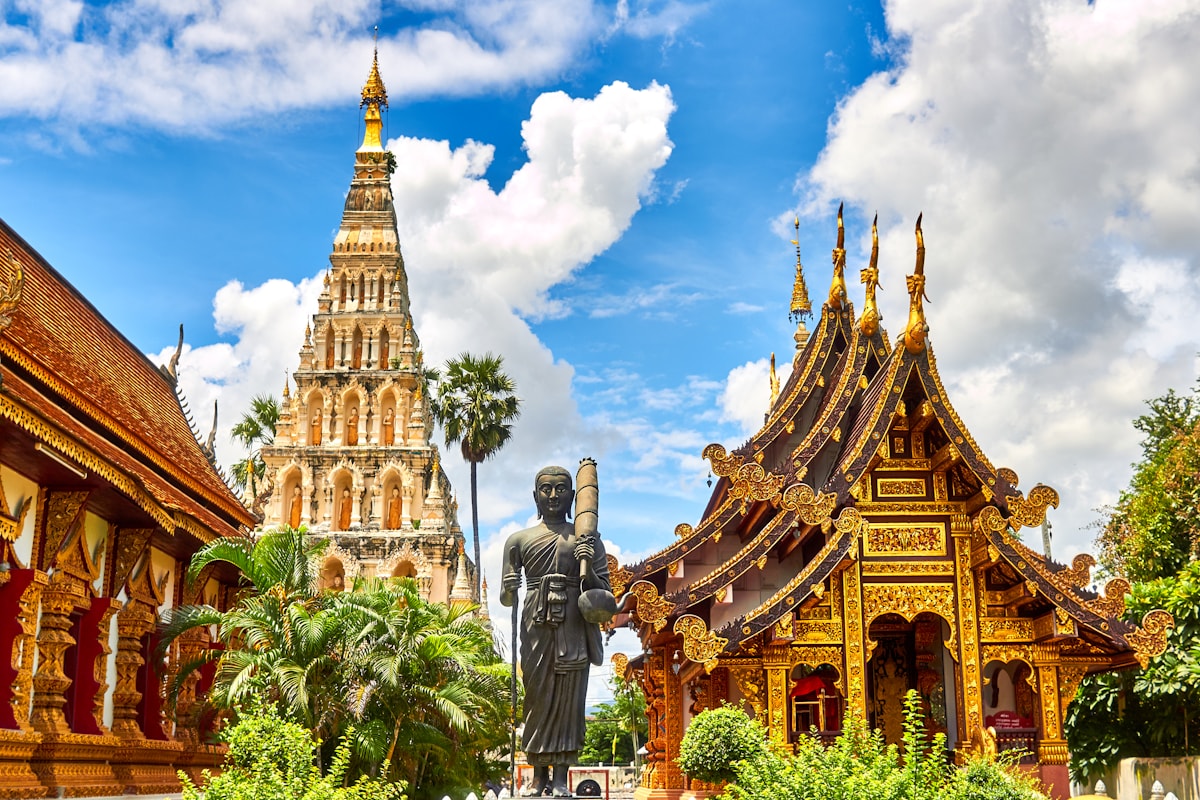
Chiang Mai’s historic moated city contains over 300 Buddhist temples — more per square kilometre than anywhere outside Bagan, Myanmar. The most important: Wat Phra Singh (15th century, finest Lanna-style temple), Wat Chedi Luang (15th century, partially destroyed by earthquake in 1545, haunting ruins), and Wat Phra That Doi Suthep on the mountain above the city (reached by 306-step naga staircase, views across the entire Chiang Mai valley).
Ethical Elephant Experience
Elephant Nature Park (founded by Lek Chailert) is the gold standard for ethical elephant tourism in Southeast Asia — a rescue sanctuary where you walk, feed, and bathe elephants without riding or performing. Full-day visits ~$80. The contrast with riding camps (still operating and genuinely harmful to the animals) makes the ethical choice essential.
Sunday Walking Street and Thai Cooking Class
Sunday Walking Street on Wualai Road transforms the old silver district into an extraordinary market of handcrafted goods, street food, and live music from 5 PM. Monday–Saturday: take a Thai cooking class (Chiang Mai is the world’s best city for this — $30–40 for half-day class including market visit, learning 6–8 dishes).
Days 8–9 — Pai: Mountain Village Tranquillity
The Pai Valley
Three hours from Chiang Mai by minivan (762 curves in the mountain road — travel sickness tablets advised), Pai is a small town in a fertile valley at 800m altitude that has attracted travellers, artists, and yoga practitioners for decades. It is still genuinely beautiful: rice paddies, bamboo bridges, hot springs, waterfalls, and the Pai Canyon (walking the narrow ridge above the valley at sunset is breathtaking).
Cultural Sites Near Pai
Wat Mae Yen (Chinese Kuomintang temple on a hillside, reached by 353 steps) for panoramic valley views. The Chinese village of Ban Santichon (Yunanese refugees from 1949) for pu-er tea and Chinese noodle soup. The Lisu and Lahu hill tribe villages near Pai for a culturally respectful introduction to minority communities.
Days 10–14 — Southern Islands: Koh Lanta and Koh Phi Phi
Koh Lanta — Relaxed Island Culture
Fly Chiang Mai→Krabi (~$40, 1.5 hours) then ferry to Koh Lanta — a long island with calm west-coast beaches, a charming old town (Ban Ko Lanta), and a significantly more relaxed atmosphere than the more famous islands. The old town’s Chinese-Malay shophouse architecture and seafood restaurants on stilts over the water are extraordinary.
Koh Phi Phi — Dramatic Limestone Landscape
A day trip or overnight to Koh Phi Phi Don — the most photogenic island in Thailand, with limestone karst cliffs rising straight from turquoise water. Maya Bay (filming location for The Beach) is now managed with limited daily visitor numbers to allow coral recovery. Snorkelling, longtail boats, and sunsets over the twin bays.
Thai Island Food Culture
Southern Thai food is the spiciest in the country — coconut milk curries with more heat than the north, fresh seafood, and the influence of Malaysian Muslim culture in southern provinces. Do not leave without eating a genuine massaman curry (arguably the most complex curry on Earth, ranking consistently in CNN’s World’s Best Foods lists) and a morning bowl of joke (rice porridge) at a waterfront market.
Cultural Etiquette & Tips
- The Wai: The pressed-palms greeting. Return a wai when given one. Do not wai service staff (they should wai you). The higher the hands, the deeper the respect.
- The head and feet: The head is sacred, feet are lowly. Never touch anyone’s head. Point feet away from Buddha images and monks. Remove shoes before entering all temples and many businesses.
- Monks: Women must never touch a monk or hand something directly to him — place items on a surface for him to pick up. On public transport, women sit away from monks.
- Royal family: Deep respect is non-negotiable — criticism is illegal under lèse-majesté laws. Stand when the royal anthem plays in cinemas.
- Temple dress: Cover shoulders and knees at all temples. Sarongs are provided at most major temples for a small fee. Flip flops are fine — you’ll remove them frequently.
Frequently Asked Questions
What is the best island in Thailand?
It depends entirely on what you want. Koh Lanta: family-friendly, relaxed, beautiful sunsets. Koh Lipe: pristine water, snorkelling, near-perfect beaches. Koh Tao: world-class scuba diving. Koh Samui: developed, resort infrastructure, lively nightlife. Koh Phi Phi: dramatic scenery, younger crowd, busier. Avoid all islands May–October (monsoon, rough seas, many businesses closed).
How spicy is Thai food really?
Street food ordered without specification will be cooked Thai-spicy — which is genuinely very spicy by most standards. Say ‘mai pet’ (not spicy) or ‘pet nit noi’ (a little spicy) when ordering. Restaurant menus abroad dramatically understate Thai food’s heat level.
Do I need vaccinations for Thailand?
Recommended: Hepatitis A and B, Typhoid, Tetanus. Consider: Japanese Encephalitis if visiting rural/jungle areas. Malaria risk is low in tourist areas but exists in jungle border regions. Consult a travel health clinic 6–8 weeks before departure.
More Travel Itineraries
Explore more cultural travel itineraries on CulturalDiaries.com — day-by-day guides to the world’s most extraordinary destinations.
One response to “2 Weeks in Thailand: Temples, Festivals & Street Food”
[…] in local restaurants; international hotels have adopted Western conventions. Southeast Asia (Thailand, Vietnam, Indonesia): Tipping increasingly expected in tourist areas — 10–15% at sit-down […]