

7 Days in India: The Golden Triangle — Delhi, Agra, and Jaipur
The India Golden Triangle itinerary — connecting Delhi, Agra, and Jaipur in a roughly 700-kilometre circuit — is the world’s most famous cultural travel route and the best introduction to India’s staggering depth of history, art, and civilisation. Seven days along this route takes you from Mughal Delhi’s domed mosques and fort-palaces to the Taj Mahal at sunrise in Agra, then west to Jaipur’s Pink City of painted havelis and hilltop fortresses. Each city represents a different chapter of the subcontinent’s extraordinary story — and each will leave you understanding why India has been drawing visitors, conquerors, and pilgrims from across the world for three thousand years.
India rewards patience and preparation in equal measure. The sensory intensity — traffic, spice, colour, noise, sacred ash and marigold garlands — can overwhelm on arrival. However, within 24 hours, that same intensity becomes the thing you will miss most when you leave. This itinerary is designed for first-time visitors. It builds in enough time to actually absorb each place rather than merely photograph it. The history and culture of Indian civilisation runs through every monument, market, and meal you will encounter — and knowing a little of it beforehand transforms the experience from sightseeing into genuine understanding.
Golden Triangle Itinerary: Quick Reference
| Best time to visit | October–March (cool and dry); avoid April–June (extreme heat, up to 45°C) |
| Currency | Indian Rupee (INR); $1 ≈ ₹83 |
| Language | Hindi (official); English widely spoken in tourist areas |
| Visa | e-Visa available for most nationalities online; apply 4+ days in advance |
| Getting around | Hire a private car and driver for the circuit — safest and most efficient ($40–60/day) |
| Budget (per day) | Budget: $25–40 | Mid-range: $60–120 | Luxury: $200+ |
| Vaccinations | Typhoid, Hepatitis A recommended; consult your doctor 6 weeks before travel |
Day 1–2: Delhi — Layers of Empire
Delhi is not one city but many — at least eight cities built atop each other over three millennia. The Old Delhi of the Mughal emperors (17th century) sits beside the New Delhi of the British Raj (early 20th century), both embedded in a modern megalopolis of 33 million people. Navigating this requires a plan, good shoes, and a high tolerance for extraordinary chaos.
Day 1 — Mughal Delhi: Begin at the Red Fort (Lal Qila), the sandstone palace-fortress built by Shah Jahan in 1648, its walls stretching 2.4 kilometres around an interior of marble halls, gardens, and audience chambers. Adjacent to it, the Jama Masjid — India’s largest mosque, built 1644–1656, accommodating 25,000 worshippers — is best visited in early morning when the courtyard fills with light and the call to prayer echoes across Old Delhi’s rooftops. Spend the afternoon in Chandni Chowk — the 17th-century market street that is simultaneously the world’s most chaotic and most exhilarating place to eat street food. Try the paranthe wali gali (fried bread alley), the spice market, and the sweet shops.
Day 2 — Imperial Delhi: The Qutub Minar (1193 CE) is a 73-metre minaret — the world’s tallest brick minaret — built to mark the arrival of Islamic rule in Delhi and surrounded by some of India’s finest early Islamic architecture, including an iron pillar from the 4th century CE that has not rusted in 1,600 years. In the afternoon, visit Humayun’s Tomb (1570 CE) — a UNESCO World Heritage Site and the architectural prototype for the Taj Mahal, its double dome and symmetrical garden the direct predecessors of Shah Jahan’s masterpiece. End the day at India Gate and Rajpath — the imperial ceremonial boulevard of New Delhi, designed by Edwin Lutyens in the 1910s on a scale designed to humble any visitor.
Day 3: Agra — The Taj Mahal at Sunrise
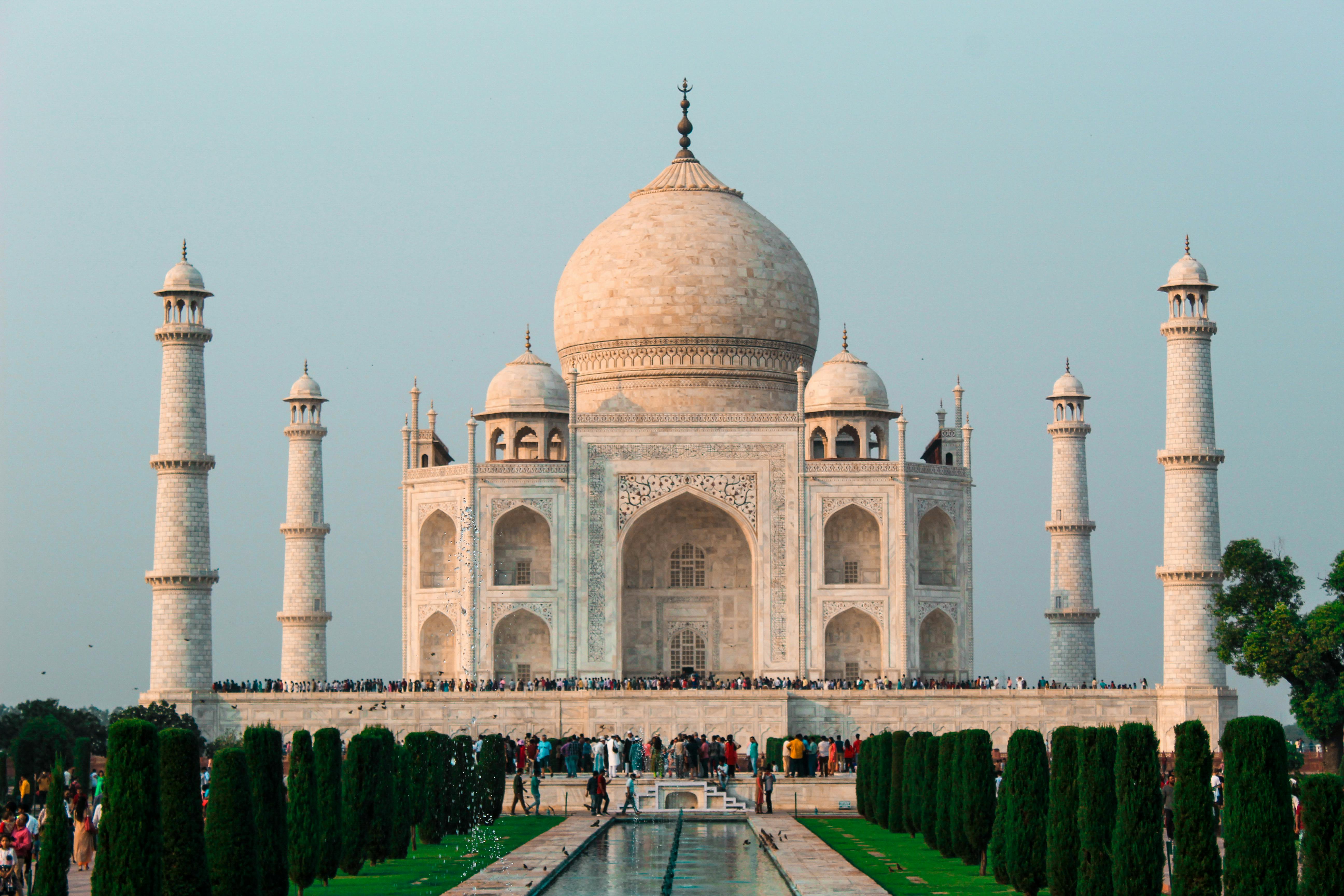
The drive from Delhi to Agra takes approximately 3–4 hours by car along the Yamuna Expressway. Arrive the evening before if possible, so you can be at the Taj Mahal gate when it opens at sunrise — 6:00 AM in winter, 5:00 AM in summer. This is non-negotiable. The Taj Mahal at sunrise, with mist on the Yamuna River and the light pink before turning white, is one of the few travel experiences that genuinely exceeds its reputation.
The Taj Mahal was built between 1632 and 1653 by the Mughal emperor Shah Jahan as a mausoleum for his wife Mumtaz Mahal, who died in childbirth. According to UNESCO’s World Heritage documentation, it employed 20,000 artisans over 22 years and used materials from across Asia — white marble from Rajasthan, jade from China, turquoise from Tibet, lapis lazuli from Afghanistan. The result is perhaps the most perfect building ever constructed: proportionally flawless from every angle, its white marble changing colour through the day from pink at dawn to gold at sunset to silver under moonlight. Spend at least 2 hours here — more if you can.
In the afternoon, visit Agra Fort (a UNESCO site) — the massive red sandstone fortress from which Shah Jahan, imprisoned by his son Aurangzeb in his final years, could see the Taj Mahal across the river. The emotional weight of that detail is considerable. Also visit the Mehtab Bagh — the garden across the Yamuna that offers the famous rear view of the Taj at sunset without the crowds of the main entrance.
Day 4: Fatehpur Sikri and the Road to Jaipur
Forty kilometres west of Agra lies Fatehpur Sikri — a complete Mughal imperial city built by Emperor Akbar between 1569 and 1585, then abandoned after just 14 years, reportedly due to water shortage. It stands today exactly as it was left: the audience hall, the private palaces, the royal game board carved into the courtyard, the mosque with its magnificent 54-metre Gateway of Victory (Buland Darwaza). It is among the world’s finest examples of Mughal architecture and receives far fewer visitors than the Taj. Allow 2 hours, then continue driving to Jaipur (2.5 hours).
Day 5–6: Jaipur — The Pink City of Rajasthan
Jaipur, the capital of Rajasthan, was painted pink in 1876 to welcome the Prince of Wales — and has remained pink ever since, by civic ordinance, creating one of the world’s most architecturally unified urban environments. It was also the first planned city in India, laid out in 1727 by Maharaja Jai Singh II according to ancient Hindu architectural principles, its grid of streets aligned with cardinal directions and divided into nine rectangular sectors mirroring the nine divisions of the universe in Hindu cosmology.
Day 5 — The City: The Hawa Mahal (Palace of Winds, 1799) — the five-storey honeycomb facade of 953 windows through which royal women could observe street life without being seen — is Jaipur’s most iconic image. The City Palace still houses the royal family of Jaipur; parts are open to visitors and contain extraordinary collections of arms, textiles, and paintings. The Jantar Mantar (UNESCO World Heritage Site) — an 18th-century astronomical observatory of giant stone instruments that measured celestial movements with extraordinary accuracy — stands in the city centre, the finest of five such observatories built by Jai Singh II.
Day 6 — The Forts: Amber Fort, 11 km from Jaipur, is the region’s greatest monument — a palace-fortress of mirrored halls, elephant gates, and terraced gardens climbing a rocky hillside above a lake. Arrive early and enter on elephant-back (the traditional method, though alternatives exist). The Sheesh Mahal (Hall of Mirrors) inside Amber Fort, its ceiling set with thousands of tiny mirrors that reflect candlelight into a simulation of a starlit night, is one of India’s most spectacular interiors. In the afternoon, visit Nahargarh Fort on the ridge above the city for panoramic views over Jaipur at sunset.
Day 7: Jaipur Markets and Return to Delhi
Jaipur is Rajasthan’s craft capital — block-printed textiles, blue pottery, gemstones, silver jewellery, leather goods, and miniature paintings are all made here and sold at quality unavailable elsewhere. The Johari Bazaar (jewellery), Bapu Bazaar (textiles), and Tripolia Bazaar (metalwork) are the most rewarding markets. Spend the morning shopping and eating — try dal baati churma (the Rajasthani staple of lentils, baked wheat balls, and sweetened crushed wheat) before the drive or flight back to Delhi. Your India Golden Triangle itinerary ends here, but Rajasthan extends much further: Jodhpur, Udaipur, Jaisalmer, and the Thar Desert all await on another trip.
Cultural Etiquette in India
- Remove shoes at temples and mosques: Always. Many sites also request modest dress — cover shoulders and knees.
- Use your right hand: For eating, giving, and receiving. The left hand is considered unclean.
- Ask before photographing people: Especially sadhus (holy men) and at religious ceremonies — a small donation is often expected.
- Bargain everywhere except fixed-price shops: Opening prices in markets are typically 2–3x the expected final price. Negotiation is expected and enjoyable.
- Water safety: Drink only bottled or purified water. Avoid ice in drinks outside reputable hotels and restaurants.
- Dress conservatively: Particularly for women outside tourist hotels. Covering shoulders and knees in public reduces unwanted attention significantly.
Frequently Asked Questions
Is the Golden Triangle safe for solo female travellers?
The Golden Triangle is among India’s most tourist-developed circuits and is generally safe. However, solo women benefit significantly from staying in reputable hotels, using pre-booked transport rather than hailing vehicles on the street, and dressing conservatively. Jaipur and Agra receive millions of visitors annually; tourist infrastructure and police presence are well-established.
Should I hire a private driver or use public transport?
A private car and driver is strongly recommended for first-time visitors — typically $40–60 per day including fuel. It gives complete flexibility, door-to-door service between monuments, and a local guide who can recommend restaurants and avoid tourist traps. Trains exist between cities but require advance booking and navigating a complex reservation system.
How far in advance should I book Taj Mahal tickets?
Book online at least 1–2 days in advance at the Archaeological Survey of India website. Weekend and holiday visits require earlier booking. Sunrise slots (first hour after opening) sell out fastest and are by far the most rewarding time to visit — the light and relative quiet are incomparably better than midday.