
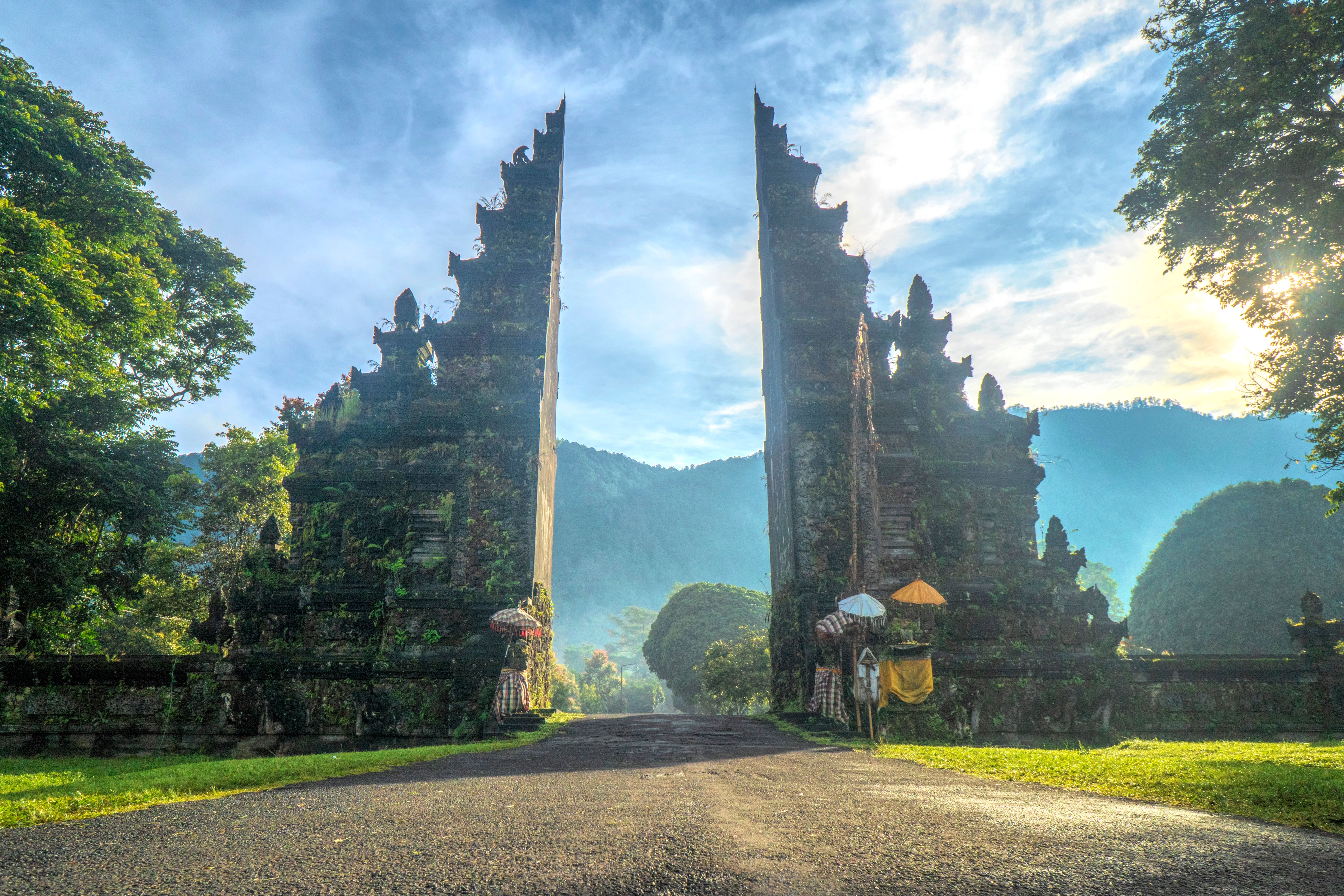
Balinese Hindu culture is one of the world’s most visually extraordinary and spiritually coherent religious traditions — a unique synthesis of Indian Hinduism, Javanese Buddhism, and ancient Austronesian animism that has shaped the island’s art, architecture, agriculture, social structure, and daily rhythm for over a thousand years. On Bali, religion is not a separate compartment of life observed on specific days in specific buildings. Balinese Hindu culture infuses every hour of every day — the small offerings (canang sari) placed at doorways each morning, the elaborate temple ceremonies that can last all night, the aesthetic choices embedded in every carved gate and painted ceiling, the agricultural decisions governed by the sacred 210-day Balinese calendar. Understanding Balinese Hindu culture is inseparable from understanding Bali itself.
Balinese Hindu Culture: Origins and Unique Character
Balinese Hinduism — known as Agama Hindu Dharma — arrived on Bali primarily from Java during the 11th–15th centuries as Hindu-Buddhist Javanese kingdoms expanded across the archipelago. According to religious scholars, when Islam swept through Java in the 15th–16th centuries, Bali’s geographic separation allowed it to preserve its Hindu-Buddhist synthesis while the rest of Indonesia converted. Consequently, Bali became a refuge for Javanese Hindu priests, artists, and aristocrats — their traditions preserved and developed in isolation from the Islamisation that transformed the surrounding islands.
The result is a form of Hinduism distinct from the Indian original. Balinese Hinduism incorporates ancestor worship, local spirit beliefs (animism), and artistic practices — shadow puppet theatre, gamelan music, ritual dance — as integral religious acts rather than cultural additions. Furthermore, the Balinese pantheon includes both Indian deities (Vishnu, Shiva, Brahma) and distinctly Balinese spirits and demons. The island’s mountains — particularly Gunung Agung (3,031m) — are understood as the dwelling of the gods; the sea is associated with demons and impurity. This mountain-sea cosmological axis organises everything from temple orientation to house construction to cremation rituals.
The Canang Sari: Daily Offerings and Their Meaning
The most visible element of Balinese Hindu culture for visitors is the canang sari — small palm-leaf basket offerings filled with flowers, rice, incense, and small food items, placed at doorways, shrines, and significant locations every morning by Balinese women. These offerings are not decorative — they are acts of gratitude and propitiation toward the spirits and divine forces present in every object and place. The flowers must be arranged in specific colour sequences (white facing east, red south, yellow west, blue-black north) corresponding to the four cardinal directions of Balinese cosmology. Making and placing the offerings takes approximately 45 minutes per day — a daily spiritual practice embedded in domestic life.
Visitors must be careful not to step on the offerings placed on the ground — this is considered deeply disrespectful. In contrast to decorations that are meant to be seen, canang sari are placed for the spirits and should be treated with the same respect one would give any active religious object.
Temple Ceremonies: Odalan and the Festival Calendar
Every Balinese temple celebrates its odalan — its anniversary festival — every 210 days according to the Balinese Pawukon calendar. Since Bali has approximately 20,000 temples, an odalan is happening somewhere on the island every single day of the year. During an odalan, the temple’s deity is believed to descend and be present in the temple, and the community gathers for prayer, offerings, music, and dance lasting one to three days. The gamelan orchestra plays through the night; legong and barong dances are performed for the deity’s entertainment as much as the community’s.
UNESCO has recognised the Balinese subak system — the cooperative water management network that governs the island’s rice terraces and is administered through water temples — as a World Heritage expression of the Tri Hita Karana philosophy (harmony between humans, nature, and the divine). This philosophy is not abstract — it governs how water flows to rice fields, which fields are planted when, and how disputes between farmers are resolved. The water temples are active religious institutions managing an agricultural system that has fed the island for a thousand years.
Nyepi: Bali’s Day of Silence
Nyepi — the Balinese New Year according to the Saka calendar — is one of the world’s most extraordinary cultural events: a 24-hour day of complete silence and inactivity observed across the entire island. On Nyepi, all businesses close, all traffic stops (including the international airport), all lights are extinguished after dark, and all residents stay indoors. The island of four million people goes quiet simultaneously. Nyepi observance enforces four prohibitions: no fire (no lights or cooking), no work, no travel, and no entertainment. The silence is for the demons — convincing them that Bali is uninhabited so they will pass over the island without causing harm in the new year.
The evening before Nyepi, communities parade enormous ogoh-ogoh — papier-mâché demon effigies that can reach six metres in height — through the streets in a noisy, torch-lit procession before burning them in a symbolic banishment of evil. The contrast between this night of noise and the absolute silence of the following day is among the most powerful cultural experiences available anywhere in Asia.