
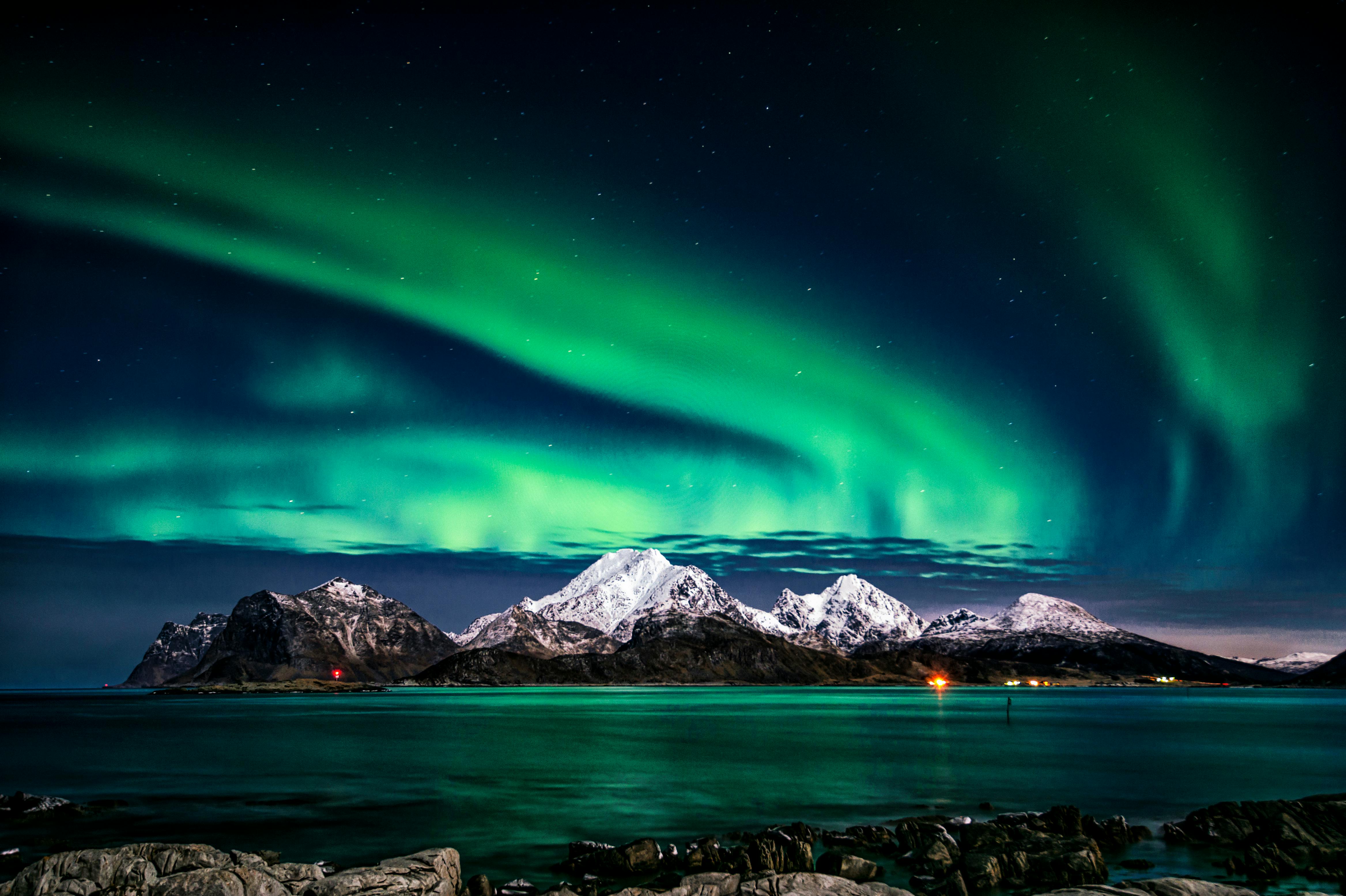
The Northern Lights — aurora borealis — are among earth’s most breathtaking natural phenomena: curtains of green, purple, red, and white light rippling across the Arctic sky in patterns that seem simultaneously natural and impossible, as if the atmosphere itself is performing. The Northern Lights have inspired mythology in every culture that has lived beneath them, driven scientific inquiry since ancient Greece, and in recent years become one of the world’s premier bucket-list travel experiences, drawing millions of visitors annually to Norway, Iceland, Finland, Canada, and Alaska. This guide covers the science behind the aurora borealis, the best places to see Northern Lights, and the cultural stories that different civilisations have told about the sky’s most dramatic display.
Northern Lights: The Science Behind the Aurora Borealis
The Northern Lights aurora borealis is produced by collisions between charged particles from the sun and gas molecules in earth’s atmosphere. According to atmospheric physicists, the sun constantly emits a stream of charged particles (electrons and protons) called the solar wind. When these particles reach earth, the planet’s magnetic field deflects most of them — but at the polar regions, where the magnetic field lines converge and re-enter the earth, the particles are channelled into the atmosphere. There they collide with oxygen and nitrogen molecules at altitudes of 100–300 km above the surface, causing the molecules to emit light — the aurora.
The colours are determined by which gas is being excited and at what altitude. Green (the most common colour) comes from oxygen at 100–150 km altitude. Red comes from oxygen at higher altitudes (above 200 km). Blue and purple come from nitrogen. Furthermore, the intensity and frequency of displays correlates with the solar cycle — the sun’s 11-year cycle of magnetic activity. During solar maximum (periods of peak activity), auroras are more frequent, more intense, and visible at lower latitudes. The current solar cycle is approaching its maximum in 2025–2026, making this an exceptional period for Northern Lights viewing.
Best Places to See Northern Lights
The Northern Lights are most reliably visible in the auroral oval — a ring-shaped zone centred on the magnetic poles, passing through northern Norway, Sweden, Finland, Iceland, Alaska, northern Canada, and the Russian Arctic. Within this zone, clear skies and darkness are the primary requirements: the aurora is always happening, but cloud cover and daylight make it invisible.
- Tromsø, Norway: The world’s most popular Northern Lights destination — above the Arctic Circle, with excellent tourist infrastructure, local guides who track real-time conditions, and a long season (September–March). Strong displays are visible 3–4 nights per week in clear weather.
- Abisko, Sweden: A small town in Swedish Lapland with a unique microclimate that produces clearer skies than surrounding areas. The Aurora Sky Station on Mount Nuolja provides an elevated viewing platform with spectacular views over Lake Torneträsk.
- Rovaniemi, Finland: The official hometown of Santa Claus, situated just on the Arctic Circle. Glass-ceiling igloo hotels allow aurora viewing from bed — a genuinely extraordinary experience.
- Reykjavik and rural Iceland: Iceland’s unpredictable weather requires flexibility, but the country’s dramatic landscape (glaciers, lava fields, geothermal hot springs) makes for the most photographically extraordinary aurora settings on earth.
- Yukon, Canada: Less visited than European destinations, the Canadian north offers genuine wilderness aurora viewing with minimal light pollution. Whitehorse is the main base.
- Fairbanks, Alaska: One of the world’s highest auroral activity zones, with displays visible on average 240 nights per year. The Geophysical Institute at the University of Alaska provides real-time aurora forecasts.
Best Time to See the Northern Lights
The Northern Lights require darkness — ruling out the Arctic summer months (May–July) when the midnight sun provides continuous daylight. The optimal season is September–March, with peak activity around the equinoxes (September and March) when solar-earth interactions are statistically strongest. Winter months (December–February) offer the longest dark periods but also the coldest temperatures (-20°C to -30°C in some locations) and more frequent cloud cover in some regions. However, winter displays above snow-covered landscapes are among the most visually extraordinary experiences available anywhere on earth.
Northern Lights Mythology Around the World
Every culture that has lived beneath the aurora has created stories to explain it. The Norse saw the Northern Lights as the light reflected from the shields of the Valkyries as they rode across the sky collecting fallen warriors for Valhalla. The Sami people of Lapland considered it dangerous to whistle at the aurora — doing so attracted the lights, which might reach down and carry the whistler away. The Algonquin people of Canada believed the aurora was Nanahbozho — the creator of earth — lighting fires to show humanity he remembered them. Meanwhile, the ancient Finnish name for the aurora — revontulet (fox fires) — derives from a myth of a magical fox running across the Arctic fells, its tail brushing the mountains and scattering sparks into the sky. In contrast, medieval European scholars interpreted intense southern auroras as omens of war or disaster — the red aurora of 1583 was recorded across Europe as a terrifying portent.
You Might Also Enjoy
- 7 Days in Norway: Fjords, Northern Lights, and Viking Culture
- 10 Days in Iceland: Fire, Ice and Norse Culture
- The Faroe Islands: Europe’s Most Remote and Breathtaking Destination
- Viking Traditions: The Ancient Norse Way of Life That Still Shapes the World
- Most Culturally Rich Countries to Visit in 2026