

7 Days in Greece: Islands, History & the Mediterranean Soul
Athens · Delphi · Santorini · Mykonos
Greece is the origin of Western civilization — democracy, philosophy, theatre, the Olympic Games, and the foundational myths that shaped two millennia of European thought all began here. But Greece is also a living Mediterranean culture of extraordinary food, passionate people, and an island archipelago of 6,000 islands that produces some of the world’s most beautiful seascapes. This 7-day itinerary combines the ancient and the beautiful.
Quick Reference
| Best Time | May–June or September–October (warm, fewer crowds, lower prices than July–August) |
| Daily Budget | EUR 80–150/day mid-range (islands are 30% more expensive than mainland) |
| Currency | Euro (€). Cards widely accepted on islands. |
| Visa | US, UK, AU, CA: visa-free 90 days in Schengen area |
| Ferry Tip | Book island ferries in advance July–August — they sell out. Blue Star Ferries most reliable. |
| Key Food | Eat lunch (not dinner) at local tavernas for the best value and authentic experience |
Day-by-Day Itinerary
Days 1–2 — Athens: The Ancient Heart of the West
Day 1 Morning — Acropolis at Opening Time
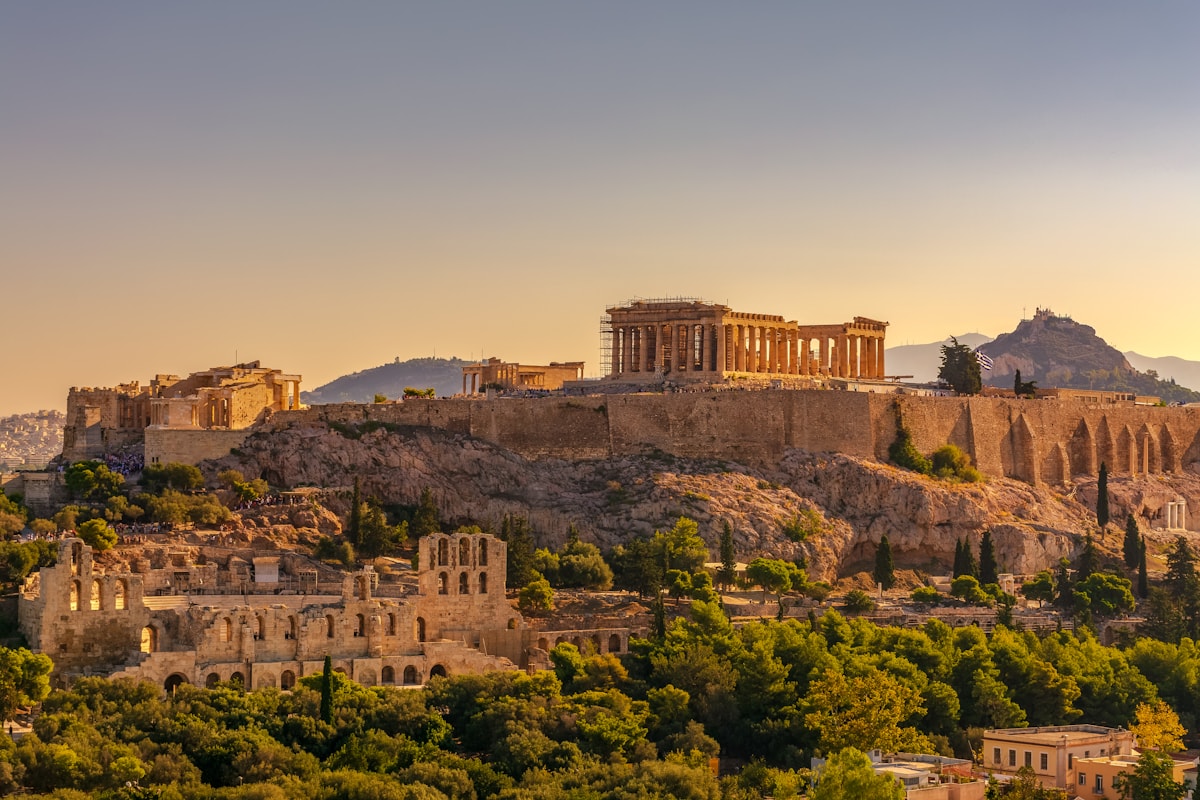
Arrive at the Acropolis (€20, book online) at 8 AM when it opens — the site is quiet, the morning light is perfect, and the honey-coloured Pentelic marble glows warmly. The Parthenon (447–432 BC) is simultaneously the most photographed and most misunderstood building in the world: it was never purely white (painted in vivid reds, blues, and golds), never perfectly symmetrical (every line is subtly curved to compensate for optical illusion), and never a ruin until 1687 (when a Venetian cannonball hit the Ottomans’ gunpowder store inside).
Day 1 Afternoon — Plaka and Monastiraki
Walk down through Plaka — Athens’ oldest neighbourhood, a maze of neoclassical mansions and Byzantine churches tucked below the Acropolis rock. The Monastiraki flea market (daily, peaks Sunday) is Athens’ most characterful market. Eat souvlaki standing up at Kostas or Thanasis on Monastiraki Square — €2.50 per stick, the finest fast food in Europe.
Day 2 — National Archaeological Museum
The finest collection of ancient Greek art in the world: the Antikythera mechanism (the world’s oldest known computer, 200 BC), the Mask of Agamemnon (Mycenaean gold death mask, 1550 BC), the Artemision Bronze (a life-size bronze Zeus or Poseidon throwing a thunderbolt, 460 BC) — the most perfect surviving figure of classical sculpture. Allow 3–4 hours minimum.
Day 3 — Day Trip to Delphi
The Navel of the World
Delphi (2.5 hours from Athens by bus, €30 return) was the most important religious sanctuary in the ancient Greek world — the seat of the Oracle of Delphi, consulted by kings, generals, and city-states for 1,000 years (800 BC – 390 AD). Perched on the dramatic slopes of Mount Parnassus above a valley of olive trees, the site includes the Temple of Apollo, the theatre, the stadium (best preserved in Greece), and the Treasury of Athens. The Delphi Archaeological Museum houses the Bronze Charioteer (478 BC) — one of the finest surviving bronzes of antiquity.

Days 4–5 — Santorini: The Caldera
The Most Dramatic Island on Earth
Santorini is the remnant of a volcanic caldera — a circular group of islands formed when a massive eruption around 1600 BC may have triggered the Bronze Age collapse of Minoan civilisation. The famous blue-domed churches of Oia and Fira cling to the cliffs of the caldera rim, 300 metres above the sea. The ‘Santorini sunset’ from Oia has been photographed more times than almost any other landscape on Earth.
Akrotiri — The Pompeii of the Aegean
The Bronze Age city of Akrotiri was buried by the volcanic eruption around 1600 BC and preserved almost perfectly — an entire 3,500-year-old city with multi-storey buildings, indoor plumbing, and extraordinary frescoes (now in Athens’ National Museum). It is one of the finest archaeological sites in Europe and receives a fraction of the visitors it deserves.
Santorini Wine and Food
The volcanic soil produces extraordinary assyrtiko white wine — mineral, crisp, and unlike any other Greek wine. Winery visits at Santo Wines or Domaine Sigalas. Food: fava (yellow split pea purée from the Cycladic island’s own variety, protected designation of origin), white aubergines, and cherry tomatoes — flavours intensified by the volcanic soil and near-zero rainfall.
Days 6–7 — Mykonos: The Cycladic Town
Hora (Mykonos Town)
Mykonos Town is a labyrinth of whitewashed cubic buildings, narrow stone-paved lanes, and blue-domed chapels — the archetypal Cycladic town. The streets were intentionally designed without a grid to confuse pirates. The pelicans (descendants of Petros, the original pelican mascot of Mykonos since the 1950s) wander the waterfront with complete authority.
Delos — Sacred Island of Apollo
A 20-minute ferry from Mykonos: Delos was one of the most important sanctuaries of the ancient Greek world — birthplace of Apollo and Artemis, once the most prosperous trading port in the Mediterranean. Today: uninhabited, no hotels, no permanent residents — just one of the most significant archaeological sites in Greece. The Terrace of the Lions (7 archaic marble lions, 600 BC) is the island’s emblem.
Final Evening
Watch the sunset from Little Venice — a row of whitewashed buildings built directly above the sea, their terraces hanging over the water. A glass of Assyrtiko as the Aegean turns gold. There are worse ways to end a trip to Greece.
Cultural Etiquette & Tips
- Philoxenia: The Greek concept of hospitality to strangers is ancient and genuine — accept the offered coffee, the free dessert, the invitation to sit. Refusing is rude.
- Eating times: Greeks eat late — lunch 2–4 PM, dinner after 9 PM. Restaurants before 8 PM are empty except of tourists.
- The evil eye (mati): Blue eye charms sold everywhere are genuine cultural practice — the belief that admiring something too enthusiastically can curse it. If someone compliments your child or possessions effusively, say ‘ftou ftou’ (spitting sound) to ward off the curse.
- Religious sites: Greece is culturally Eastern Orthodox — women must cover shoulders and knees at monasteries and churches. This is especially enforced at Meteora monasteries and Mount Athos.
- Bargaining: Not practised at shops or restaurants. Expected at antique markets and souvenir stalls.
Frequently Asked Questions
How do I get between Greek islands?
Ferries are the primary transport — Blue Star Ferries, SeaJets, and Hellenic Seaways operate routes between most islands. Santorini–Mykonos: 2–3 hours by fast ferry (~€60). Book in advance July–August. Domestic flights exist (Aegean Airlines, Sky Express) and are worth it for long distances.
Is Greece expensive?
Islands are significantly more expensive than the mainland — Santorini and Mykonos are 40–60% pricier than Athens. Budget travellers can survive on €50/day on less famous islands; Santorini mid-range hotels easily cost €200+/night. Athens is excellent value by European capital standards.
What is the best Greek island?
It depends entirely on what you want. Santorini: dramatic beauty, volcanic landscape, excellent wine. Mykonos: sophisticated nightlife, Cycladic architecture, gay-friendly. Crete: the largest island, rich history (Minoan ruins at Knossos), varied landscape, best food. Rhodes: medieval city, beach resorts, history. Milos: extraordinary coloured cliffs, dramatically underrated. Naxos: most beautiful Cycladic island for local life, far fewer tourists than Santorini.
More Travel Itineraries
Explore more cultural travel itineraries on CulturalDiaries.com — day-by-day guides to the world’s most extraordinary destinations.
5 responses to “7 Days in Greece: Islands, History & the Mediterranean Soul”
[…] in the 8th-9th centuries CE, drawing on two primary sources: the geometric traditions of ancient Greece (particularly Euclid’s Elements, translated into Arabic during the great translation movement […]
[…] trading empire that controlled the frankincense and spice routes connecting Arabia, India, and the Mediterranean from around 400 BC to 106 AD when Rome annexed it. The Nabataeans were extraordinary hydraulic […]
[…] (montaditos): Small servings on bread — the Catalan variation tends toward more Mediterranean ingredients and the influence of France and Italy is […]
[…] from Istanbul’s 2,000-year history through the volcanic lunar landscape of Cappadocia to the Aegean […]
[…] 7 Days in Greece Itinerary […]